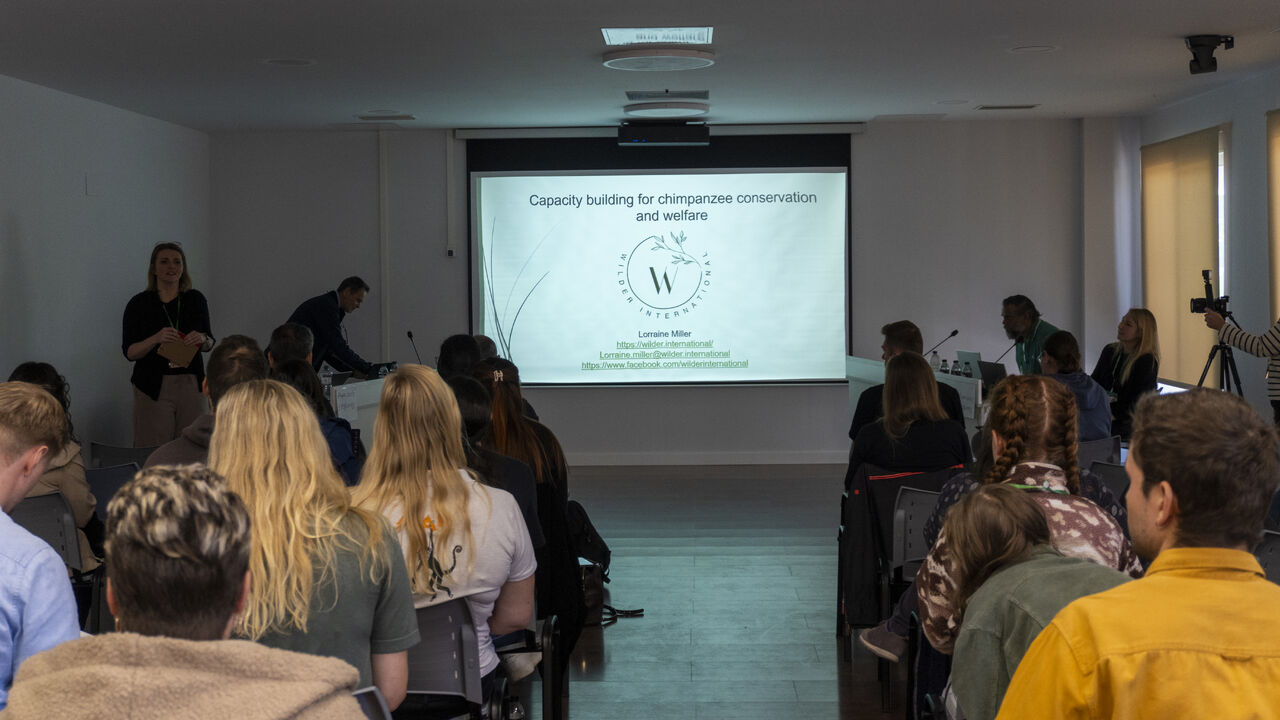
This week saw specialists in chimpanzee care and protection gather together for the very first chimpanzee workshop of the European Association of Zoos and Aquariums. Hosted by Valencia Bioparc, this group of 50 wildlife health, care and conservation professionals from 12 countries successfully shared essential research and knowledge on topics as critical as illegal trafficking, nutrition, health, and physical and emotional well-being, all aimed at ensuring the survival of this critically endangered species and enhancing their welfare in human care


Over two days, presentations, open discussions and practical sessions were held on such topics as chimpanzee nutrition, veterinary care, behaviour, education and in situ conservation. The aim of these sessions were to share knowledge and up to date research on these topics in order to enhance chimpanzee welfare and population management in human care as well as support their conservation in the wild.
Wilder International was invited to deliver presentations on chimpanzee behaviour and capacity building for conservation, whilst supporting the event’s nutrition workshop. We were also pleased to have delivered a shared presentation on chimpanzee communication alongside the European animal welfare organisation, Animal Advocacy and Protection (AAP) who house rescued chimpanzees at their sanctuaries in Spain and the Netherlands.
Thomas Marques, from the Institute of Evolutionary Biology at Pompeu Fabra University and recipient of the Ramón y Cajal Medal from the Royal Academy of Sciences, spoke of his work on the illegal trafficking of chimpanzees. In his genetic research, he highlighted the implementation of a non-invasive system that allows for the identification of the origin of individuals through faecal analysis. The goal being to ascertain where trafficked individuals originated from in order to prevent new cases of illegal trafficking. The intervention is carried out in these “hotspots” so that the United Nations, through its Great Ape Survival Partnership (GRASP), can take action through awareness campaigns aimed at local communities.
Jana Pluháčková and Arun Idoe, EEP chair and vice coordinator, hosted the event covering many topics from chimpanzee welfare assessments to the importance of collaborative working, both in situ and ex situ. Other speakers covered topics including physical and emotional health, the importance of education in chimpanzee conservation and chimpanzee social structures and hierarchical changes.
We would like to say a huge thank you to the Chimpanzee Endangered Species Breeding Program coordinators for the invitation to contribute to this important event and to the staff at Valencia Bioparc for their hospitality.